Give Your Character a Test

There are a lot of ways to get inside your character’s head: give that character a test, perform some transactional writing with them, or even pull out the all the Gestalt stops and use an empty chair to have a conversation. While I won’t pretend to say one way is better than another, I can give you my thoughts on how I use (and you can use) the DiSC personality assessment to really understand your character’s motivations and how they behave in the world in which you placed them.
First off, what the heck is DiSC?
DiSC is a personality assessment based on the work of William Marston (psychologist, inventor of the systolic blood pressure test, creator of Wonder Woman) outlined in his book The Emotions of Normal People published in 1928. In that book, Marston divides all human behavior into four basic dimensions:
- Dominance: To direct and challenge, sometimes referred to as “Directing” or “Drive”
- Influencing: To influence and verbalize; Marston’s original term was “Inducement”
- Steadiness: To serve and accommodate; also “Steadfastness” or “Submission” (the latter being Marston’s preferred name)
- Conscientiousness: To comply to high standards, sometimes referred to as “Compliance” or “Caution”
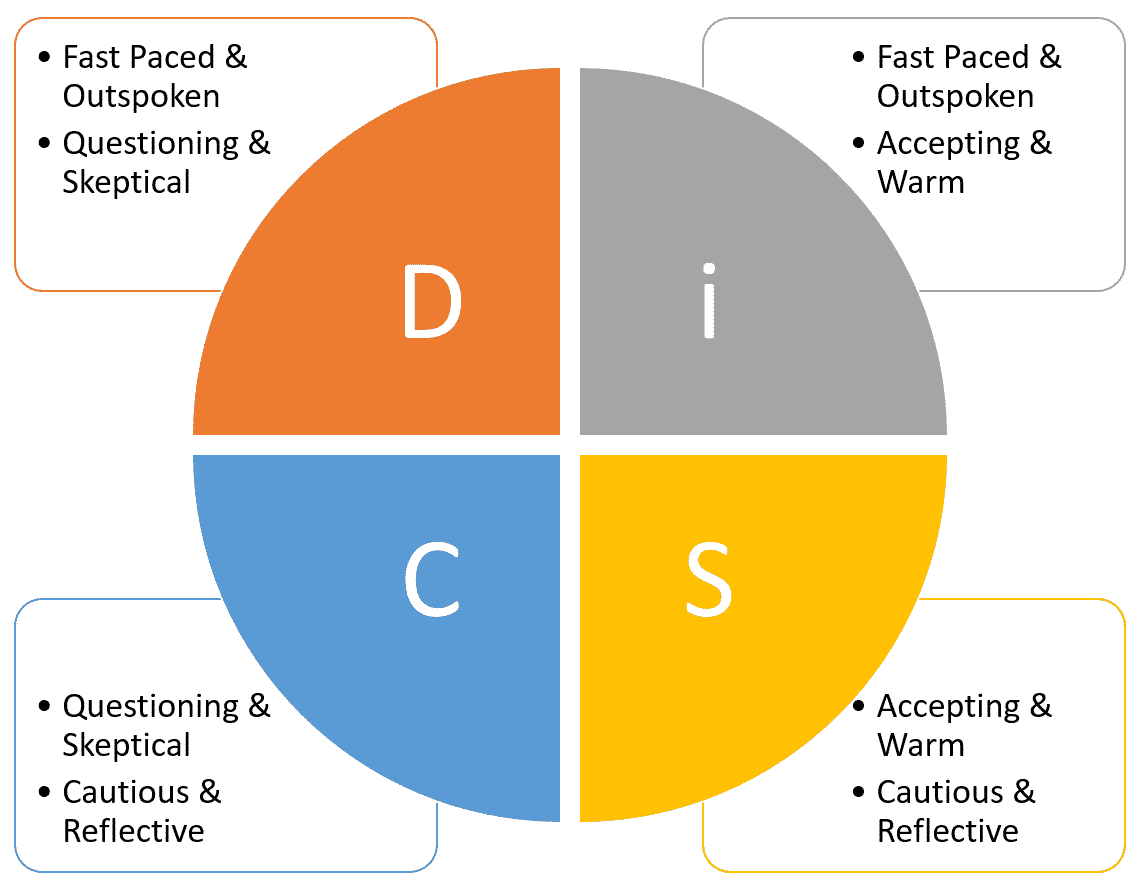
DiSC examines observable behavior and emotions and is correctly called a behavioral analysis. DiSC is an acronym for Dominance, Influencing, Steadiness and Conscientious behaviors. Unlike many other personality assessments (which I will not debate here), DiSC shows no preferences by race, gender, ethnicity, or religious affiliation.
Caveat: The first DISC surveys were published in 1956, refined in 1958 and have been in use since. DiSC has been validated but is not infallible. For example, an individual could give answers on a survey other than their true feelings.
Counter to that caveat: That’s where this post comes in. This is not about you, but your character(s). You are going to give answers that are not your own.
DiSC identifies how people respond to problems, people, pace and procedures, and provides nonjudgmental language for exploring behavioral issues across these four primary dimensions. While people tend strongly toward one or two styles, there is no right or wrong place to be. All people display the four dimensions in varying intensity.
Your character’s behavior is a necessary and integral part of who they are. Much of that behavior comes from “nature” (inherent), and much comes from “nurture” (upbringing). A DiSC profile helps us better understand them and how they interact with the world.
This is true for our characters as it is for ourselves: What we are is determined by our intelligence, skills and knowledge, and education and training. Why we are that way is based on our values.
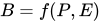
To put it in terms used by Kurt Lewin, a psychologist in the early 20th Century: our behavior is a function of our person within an environment. There’s a cool formula for that, if you can’t remember it:
So, how can we use this information to further define our characters?
Simple: give them the assessment.
While there are a few companies online that provide the test for a fee, I recommend (and get no kickback from) the following: https://www.123test.com/disc-personality-test/
In this version of the assessment, there are 28 groups of four statements.
First, get into the “mood” of your character. Then answer each statement honestly and spontaneously, thinking about how they would respond (not you). It should take you only 5 to 10 minutes to complete for each character.
- Study all the descriptions in each group of four
- Select the one description that you consider most like your character (
 )
) - Study the remaining three choices in the same group
- Select the one description you consider least like your character (
 )
)
For each group of four descriptions you should have one most like your character and only one least like your character.
In the end, you will be given a brief description of the result (a primary dimension). Use the following to help you flesh out your character more. Are they acting this way? Are you being honest about their personality, or are you mixing their style with someone else?
As you read through the following, think of a character you know–either your own or in a book you recently read. What dimension of behavior would you give them?
Dominance
- Primary Traits
- Strong willed, strong minded
- Likes accepting challenges, taking action, getting immediate results
- Very active in dealing with problems
- Described as demanding, forceful, egocentric, strong-willed, driving, determined, ambitious, aggressive, pioneering
- What’s the Opposite?
- Conservative, low-key, cooperative, calculating, cautious, undemanding, mild, agreeable, modest, peaceful
- Value to Your Plotline
- Results focused
- Self starter
- Places high value on time
- Challenges the status quo
- Innovator
- Possible limitations
- Overstep authority
- Be argumentative
- Dislike routine
- Take on too much
- For effective communication:
- Be clear, specific, brief, to the point
- Stick to business
- Don’t ramble on or waste their time
- Plan your presentation efficiently
- Take issue with the facts, not the person
- Don’t direct or order
Influencing
- Primary Traits
- Influence others through talking and activity
- Tend to be emotional
- Described as “people people”, outgoing, convincing, magnetic, political, enthusiastic, persuasive, warm, demonstrative, trusting, optimistic
- What’s the Opposite?
- Influenced by data and facts, not feelings
- Described as reflective, factual, calculating, skeptical, logical, suspicious, matter of fact, pessimistic, critical
- Value to Your Plotline
- Creative problem-solving
- Motivates others toward goals
- Provides positive sense of humor
- Negotiates conflicts
- Verbalizes articulately
- Possible limitations
- More concerned with popularity than results
- Be inattentive to detail
- Over talks
- Tendency to be situational listener
- For effective communication
- Leave time for relating, socializing
- Ask for opinions/ideas regarding people
- Don’t legislate or muffle; don’t over control the conversation
- Provide ideas for implementing action
- Don’t talk down to them
Steadiness
- Primary Traits
- Want steady pace, security, no sudden change
- Perform in consistent and predictable manner
- Good listener
- Described as calm, relaxed, patient, stable, possessive, predictable, deliberate, consistent, unemotional, poker-faced
- What’s the Opposite?
- Like change and variety
- Described as restless, demonstrative, impatient, eager, impulsive
- Value to Your Plotline
- Dependable and loyal team player
- Works for a leader and a cause
- Good listener
- Patient and empathetic
- Good at reconciling factions
- Possible limitations
- Strive to maintain status quo
- Take a long time to adjust to change
- Have difficulty establishing priorities
- Take criticism of their work as a personal affront
- For effective communication
- Show sincere interest in them as a person
- Don’t rush headlong into the issues
- Patiently draw out personal goals
- Don’t be domineering or demanding; don’t threaten with position power
- Present your case softly, non-threateningly
Conscientious
- Primary Traits
- Adhere to rules, regulations, and structure
- Do quality work, do it right the first time
- Stickler for quality, plans ahead
- Described as careful, cautious, exacting, neat, systematic, diplomatic, accurate, tactful
- What’s the Opposite?
- Challenges the rules
- Described as restless, demonstrative, impatient, eager, impulsive
- Value to Your Plotline
- Objective, “anchor of reality”
- Conscientious and steady
- Comprehensive worker
- Defines, clarifies, gets information
- Maintains standards
- Possible limitations
- Hesitate to react
- Be bound by procedures and methods
- Get bogged down in details
- Yield position to avoid controversy
- Prefer not to verbalize feelings
- For effective communication
- Prepare your case in advance
- Approach in straightforward way; stick to business
- Don’t be disorganized or messy
- Provide solid, tangible, practical evidence
- Don’t rush the decision-making process
Interactions
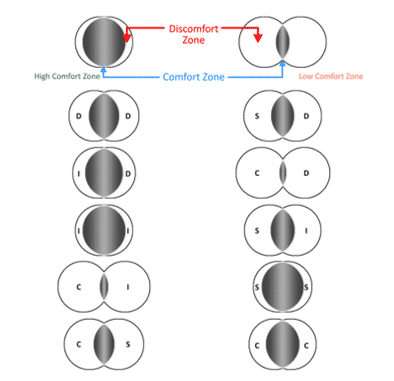
Finally (and very important) is how your characters may interact with each other upon their first meeting. This is not to say they will stay that way, but let’s say your hero behaves in a C-type manner and they meet someone who behaves in an i-type manner.
The following chart depicts the level of comfort (grey) versus discomfort (white) between styles at first glance.
See that C and i? They aren’t too comfortable with each other when they first meet, are they?